



18 Jan What Is a Tigerfish? Zimbabwe’s Fierce Freshwater Predator
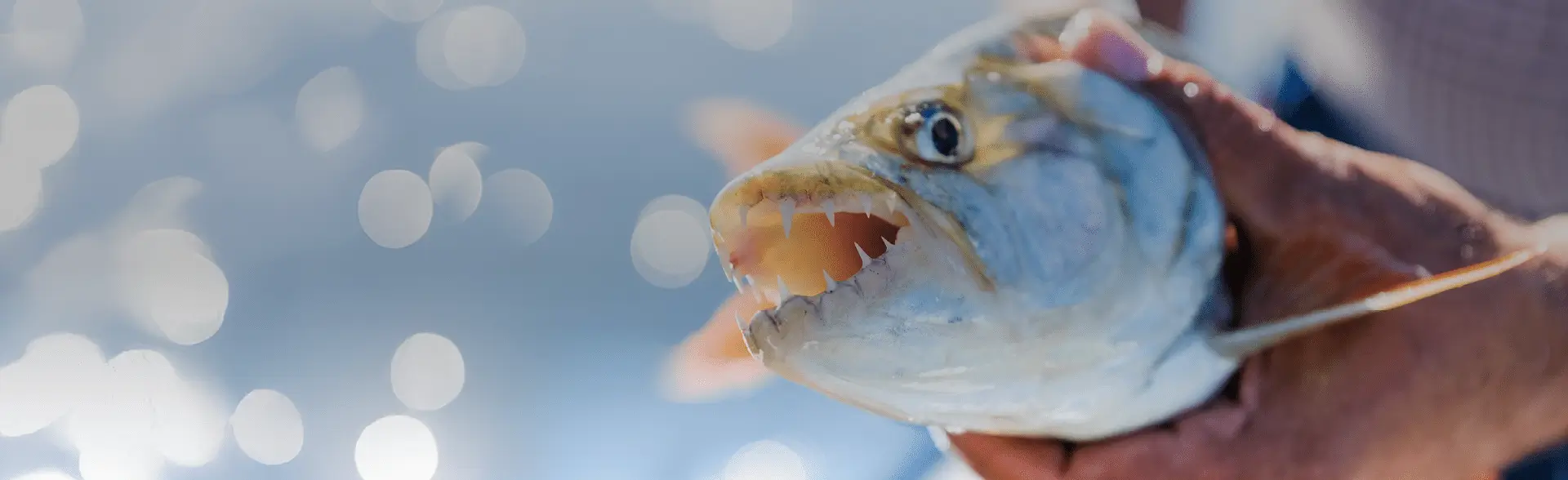
[vc_row css_animation=”” row_type=”row” use_row_as_full_screen_section=”no” type=”full_width” angled_section=”no” text_align=”left” background_image_as_pattern=”without_pattern”][vc_column][vc_column_text css=””]Fast, powerful, and equipped with a set of large, razor-sharp pointed teeth, the tigerfish is one Zimbabwe’s most impressive wildlife predators.
Although most people instantly think of lions, leopards and other mammals when discussing predators, the tigerfish patrols the waters of the Zambezi River and Lake Kariba with a ruthless efficiency that elevates it to a class of its own.
Females, which are bigger than males, grow to about 70 cm in length, and can weigh as much as 15 kg (33 lb.). As adult tigerfish specialise in eating other fish, the young eat insects and tiny animals called zooplankton, and are able to kill prey over 40% of their size.
Smaller tigerfish often form shoals and hunt near the surface which make them vulnerable to attacks from Fish eagles.
Marked with well defined dark longitudinal stripes, and red fins and tail, (although the colour varies in intensity), the tigerfish is a sought-after angling species in Zimbabwe and other parts of Africa. They are common in the Zambezi River and Lake Kariba and are found in a number of other large rivers in Zimbabwe including the Runde and Save Rivers.
An annual tigerfish angling tournament has been held on Lake Kariba since 1962 and attracts hundreds of participants from across the region and even from as far afield as Europe and the U.S.A.
The tournament enforces a strict “catch and release” policy and is an important tourism drawcard in the town of Kariba.
Flyfishing for tigerfish is also popular, especially on the Upper and Middle Zambezi River.
Four other species of tigerfish are found in large rivers of Central Africa as well as the Niger River in West Africa and the Nile River.[/vc_column_text][vc_column_text css=””]
References and further reading:
The Complete Guide to Freshwater fishes of Southern Africa – Paul Skelton.
[/vc_column_text][/vc_column][/vc_row]
